
Details
DRM: Readium LCP DRM
Weitere Details
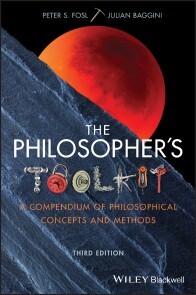
The Philosopher's Toolkit
eBook - A Compendium of Philosophical Concepts and Methods
Beschreibung
A new edition of the bestselling guide to the study of philosophy: the ideal intellectual toolkit for sharpening analytical skills and building philosophical acuity
Whether used as a guide to basic principles or a resource for key concepts and methods, The Philosopher's Toolkit equips readers with all the intellectual tools necessary for engaging closely with philosophical argument and developing fluency in the methods and language of philosophical inquiry. Featuring accessible explanations, practical examples, and expert guidance, this text empowers readers to understand traditional philosophical thinking and to engage with new ideas.
- Focuses on the practical methods and concepts necessary for philosophical inquiry
- Presents a versatile resource for both novice and advanced students in areas of philosophy, critical theory, and rhetoric
- Adopts a pluralistic approach to teaching philosophy, making this a suitable resource for many courses
- Delivers extensive cross-referenced entries, recommended readings, and updated online resources
- Covers an array of topics, from basic tools of argumentation to sophisticated philosophical principles
- Fully revised and updated to include new topics and entries as well as expanded recommended reading lists to encourage further study
Über Peter S Fosl, Julian Baggini
Peter S. Fosl is Professor of Philosophy and Chair of PPE at Transylvania University, Kentucky. He is author ofHume's Scepticism (2020), co-author ofThe Critical Thinking Toolkit (Wiley Blackwell, 2016) andThe Ethics Toolkit (Wiley Blackwell, 2007), editor ofThe Big Lebowski and Philosophy (Wiley Blackwell, 2012), and co-editor ofPhilosophy: The Classic Readings (Wiley Blackwell, 2009).
Julian Baggini is Academic Director of the Royal Institute of Philosophy and an Honorary Research Fellow at the University of Kent. He was the founding editor ofThe Philosophers' Magazine and has written for numerous newspapers and magazines, as well as for the think tanks The Institute of Public Policy Research, Demos, and Counterpoint. He is the author, co-author, or editor of over 20 books, includingHow the World Thinks, The Virtues of the Table, The Ego Trick, Freedom Regained, andThe Edge of Reason.
Inhalt
Acknowledgements xiii
Alphabetical Table of Contents xv
Preface xix
Internet Resources for Philosophers xxi
1 Basic Tools for Argument 1
1.1 Arguments, premises, and conclusions 1
1.2 Deduction 7
1.3 Induction 9
1.4 Validity and soundness 15
1.5 Invalidity 19
1.6 Consistency 21
1.7 Fallacies 25
1.8 Refutation 28
1.9 Axioms 31
1.10 Definitions 34
1.11 Certainty and probability 38
1.12 Tautologies, selfcontradictions, and the law of noncontradiction 42
2 More Advanced Tools 47
2.1 Abduction 47
2.2 Hypotheticodeductive method 51
2.3 Dialectic 55
2.4 Analogies 58
2.5 Anomalies and exceptions that prove the rule 61
2.6 Intuition pumps 64
2.7 Logical constructions 66
2.8 Performativity and speech acts 69
2.9 Reduction 72
2.10 Representation 76
2.11 Thought experiments 80
2.12 Useful fictions 82
3 Tools for Assessment 85
3.1 Affirming, denying, and conditionals 86
3.2 Alternative explanations 90
3.3 Ambiguity and vagueness 93
3.4 Bivalence and the excluded middle 97
3.5 Category mistakes 100
3.6Ceteris paribus102
3.7 Circularity 104
3.8 Composition and division 108
3.9 Conceptual incoherence 110
3.10 Contradiction/contrariety 112
3.11 Conversion, contraposition, obversion 115
3.12 Counterexamples 118
3.13 Criteria 121
3.14 Doxa/paradoxa 123
3.15 Error theory 125
3.16 False dichotomy 128
3.17 False cause 129
3.18 Genetic fallacy 132
3.19 Horned dilemmas 135
3.20 Is/ought gap 138
3.21 Masked man fallacy 141
3.22 Partners in guilt 143
3.23 Principle of charity 145
3.24 Questionbegging 149
3.25 Reductios 152
3.26 Redundancy 154
3.27 Regresses 156
3.28 Saving the phenomena 158
3.29 Selfdefeating arguments 161
3.30 Sufficient reason 164
3.31 Testability 167
4 Tools for Conceptual Distinctions 171
4.1A priori/a posteriori172
4.2 Absolute/relative 176
4.3 Analytic/synthetic 179
4.4 Belief/knowledge 182
4.5 Categorical/modal 185
4.6 Cause/reason 186
4.7 Conditional/biconditional 189
4.8De re/de dicto191
4.9 Defeasible/indefeasible 194
4.10 Entailment/implication 196
4.11 Endurantism/perdurantism 199
4.12 Essence/accident 202
4.13 Internalism/externalism 205
4.14 Knowledge by acquaintance/description 208
4.15 Mind/body 211
4.16 Necessary/contingent 215
4.17 Necessary/sufficient 219
4.18 Nothingness/being 221
4.19 Objective/subjective 225
4.20 Realist/nonrealist 227
4.21 Sense/reference 230
4.22 Substratum/bundle 232
4.23 Syntax/semantics 234
4.24 Universal/particular 236
4.25 Thick/thin concepts 239
4.26 Types/tokens 241
5 Tools of Historical Schools and Philosophers 245
5.1 Aphorism, fragment, remark 245
5.2 Categories and specific differences 248
5.3Elenchusandaporia251
5.4 Hegels master/slave dialectic 254
5.5 Humes fork 257
5.6 Indirect discourse 260
5.7 Leibnizs law of identity 263
5.8 Ockhams razor 267
5.9 Phenomenological method(s) 270
5.10 Signs and signifiers 273
5.11 Transcendental argument 276
6 Tools for Radical Critique 281
6.1 Class critique 281
6.2Différance,deconstruction, and the critique of presence 284
6.3 Empiricist critique of metaphysics 286
6.4 Feminist and gender critiques 289
6.5 Foucaultian critique of power 292
6.6 Heideggerian critique of metaphysics 296
6.7 Lacanian critique 298
6.8 Critiques of naturalism 300
6.9 Nietzschean critique of ChristianPlatonic culture 303
6.10 Pragmatist critique 305
6.11 Sartrean critique of bad faith 308
7 Tools at the Limit 311
7.1 Basic beliefs 311
7.2 Godel and incompleteness 314
7.3 Hermeneutic circle 316
7.4 Philosophy and/as art 319
7.5 Mystical experience and revelation 322
7.6 Paradoxes 325
7.7 Possibility and impossibility 328
7.8 Primitives 332
7.9 Selfevident truths 334
7.10 Scepticism 337
7.11 Underdetermination and incommensurability 341
Index 345
E-Book Informationen
Alle hier erworbenen E-Books können Sie in Ihrem Kundenkonto in die kostenlose PocketBook Cloud laden. Dadurch haben Sie den Vorteil, dass Sie von Ihrem PocketBook E-Reader, Ihrem Smartphone, Tablet und PC jederzeit auf Ihre gekauften und bereits vorhandenen E-Books Zugriff haben.
Um die PocketBook Cloud zu aktivieren, loggen Sie sich bitte in Ihrem Kundenkonto ein und gehen dort in den Bereich „E-Books“. Setzen Sie hier einen Haken bei „Neue E-Book-Käufe automatisch zu meiner Cloud hinzufügen.“. Dadurch wird ein PocketBook Cloud Konto für Sie angelegt. Die Zugangsdaten sind dabei dieselben wie in diesem Webshop.
Weitere Informationen zur PocketBook Cloud finden Sie unter www.meinpocketbook.de.
Allgemeine E-Book-Informationen
E-Books in diesem Webshop können in den Dateiformaten EPUB und PDF vorliegen und können ggf. mit einem Kopierschutz versehen sein. Sie finden die entsprechenden Informationen in der Detailansicht des jeweiligen Titels.
E-Books ohne Kopierschutz oder mit einem digitalen Wasserzeichen können Sie problemlos auf Ihr Gerät übertragen. Sie müssen lediglich die Kompatibilität mit Ihrem Gerät prüfen.
Bei E-Books die mit Readium LCP geschützt sind erscheint bei dem ersten Öffnen auf ihrem Reader ein Hinweisfenster mit der Aufforderung ein Passwort einzugeben. Gleichzeitig öffnet sich ein Infofeld in dem das Passwort steht. Tragen Sie dieses Passwort in das Eingabefeld ein und bestätigen Sie die Eingabe. Danach öffnet sich das E-Book automatisch. Um E-Books die mit Readium LCP geschützt sind auf einem Tablet/Laptop/Smartphone lesen zu können, benötigen Sie ein Programm, das in der Lage ist, mit diesem Kopierschutz umzugehen. Das ist z.B. der Thorium Reader (Windows, Mac, Linux) oder die PocketBook App (iOS, Android). Fügen Sie das heruntergeladene E-Book in das Programm ein. Bei dem ersten Öffnen erscheint ein Hinweisfenster mit der Aufforderung ein Passwort einzugeben. Gleichzeitig öffnet sich ein Infofeld in dem das Passwort steht. Tragen Sie dieses Passwort in das Eingabefeld ein und bestätigen Sie die Eingabe. Danach öffnet sich das E-Book automatisch.